Oral history can be described as a dialogic discourse seeking for a connection between biography and history, between the individual experience and transformation of the society and the others. But to what extent a history can be personified or a personal life can be historic is still uncertain. Alessandro Portelli in his article Oral History as Genre argues that “oral history expresses the awareness of the historicity of personal experience and of the individual’s role in the history of society and in public events: wars, revolutions, strikes, floods, etc”. It does not mean that oral history is something untold or never been brought into focus rather they are the stories narrated several times before, but in fragments. People use to narrate their lived experiences to their children or their friends whenever they feel like sharing but those stories are neither told with a purpose of accounting nor are they organised based on the events followed. But when these experiences are shared before a historian, it legitimises the interviewer with a sense of authority and he becomes more self-aware than before.
Defining the difference between a biography and an oral history, he argues that “oral history shifts between performance-oriented narrative and content-oriented document, between subject-oriented life story and theme-oriented testimony. Auto-biograpghy or a biography emphasises on the personality and its position or importance in the society. They are focused on maintaining the image of a public figure. But in an oral history, the interviewee generally reaches to the bottom of the society and tried to focus on a theme rather than the personality. And this is the reason, these interviewees starts with the responses like “I don’t know much about it” or “I have noting significant to tell”. Sometimes, they may also give reference to some other people who they feel more intellectual or can contribute better in writing history. But as the interviewer proceed with him, he develops a sense of authority and starts sharing his experiences in a more structured way.
India has always been known for its civilizational culture and tolerance among its people. Then what has happened in 1947 which challenged the unity in its diversity. What has led to the partition of the country into India and Pakistan. Who got benefited from this decision to divide and who were the sufferer? How the decision has impacted the lives of the common people?
It has been seventy-three years after the partition of India but its scars can still be felt over the people of the country. While talking to Mr. Radha Krishan Bhagia, a retired assistant manager in the Reserve Bank of India, I learnt the different aspects of partition on the lives of people. He was one of those 10-12 million people who got displaced during partition along the religious lines, creating overwhelming refugee crises.
Mr. Bhagia came to India in 1947 at two years of age. He went to a school run by the government in military barracks and then did his graduation from the Somaiya college in Mumbai after which he joined the Reserve Bank of India in 1965 and worked there till 2002. Being a curious child, he always used to ask questions about the existing situation there from his father, grandfather or from other people and hence his knowledge and experience can become a great source of information for us and the coming generation ahead.
Lives before the Partition
His family were based in Kandavaro village in Nawab Shah district of Sindh province in undivided India. After the partition, they took a ship from Karachi, reached Gandhidham port in Gujarat and lived there for an year at the bank of Sabarmati river. Then, they went to Kota in Rajasthan and stayed there for another year and finally settled in Mumbai after 2-3 years of wondering in search of jobs.
In our conversation with Mr. Bhagia, he provided us with a detailed description of the lives, food, language, culture, demography and the political preferences of the people there. In the Sindh province, there were about six million Sindhis living there out of which 2.6 million were Hindu Sindhis and the rest were either Muslim or Sikh Sindhis. When asked about the relationship among them he told that they all, despite of their religions, lived together and also celebrated their festivals together. Sindhis were primarily Hindus but they started changing their religion from the 11th century onwards. The anger and conflict among them started at the end of the 18th century when Liyakat Ali and Zinnah started provoking people against each other. There was no such conflict before that as those 60% were also Hindus in their origin.
Their main language was Sindhi and two different scripts were used for writing: Devanagari and Arabi. They used another language Hatwanki(Hat means shop) primarily for trade purpose. It was a mixture of both Gurumukhi and Devanagari. Explaining the history of Sindhi language, he told us that Hindi literature was completely destroyed after the attacks of Muslims in India and they imposed their Persian language over them. Their script was Devanagari but it could not last for long because 60-65% of the population converted their religion into Muslims. But the question of script came back into picture when the British came to India. They announced the Devanagari script as the real script of Sindhi society. But when it was challenged by the Sindhi Muslim society, the Britishers realized that 60% of the population are Muslims here. So, they announced the Arabi script as the real script of Sindhi society.
Most of the Muslims were labourers and worked under the Hindu landowners. People from the Sindh also travelled to another British provinces like China, Mongolia and Russia for trade purposes. They used to do banking there. According to him, the business of banking has been started by the Sindhi society. What we call Promissory notes today (like bonds) they used to call them “Hundi”. It was done by the Sindhi people moving into foreign countries. They used to go by walking which took three to four months to reach there. It was a risky job though.
How did Partition change their lives?
The Hindu society was not even ready for the partition because of the continuous assurance given to them by Gandhi and Nehru. They were living a normal life there. But when the partition became a reality, they had to leave the country suddenly leaving everything behind. They left their homes only with a pair of cloth and some jewellery which the women could hide inside their clothes, although most of which were seized by them. Sometimes, they also keep the young women of their families with them. Such cases were less in Sindh though but were very high in Punjab. When Punjabi Sikh society tried to hide in the Gurudwaras, they put the whole Gurudwara on fire. Several people got burnt inside. They also used to kill the people sitting inside the train leaving for India.
The Muslims there left only enough space for one or two persons to walk at a time in the streets. “The Muslims (Mujahidin) who came from Bihar and other places in India and also the people (Muslims) living there were standing on both sides of the street and the Hindus had to walk through that only so that they could not carry any luggage with them.”
Most of them came to India by either ships, trains or some other local transports. People who came by trains tell us that half of the trains used to be filled with dead bodies.Almost every family has lost at least one or two of its members. Mr. Bhagia recalls an incident with his friend who was not even allowed to bring his father’s dead body with him who was shot dead by them. His friend did not even get to know what had happened to his father’s dead body there.
Once came to India, the refugees were kept in the military barracks to live in and were provided rations by the government there. The barracks were of the length of 6-8 boogies of a train without any walls separating them in between. There was no facility for water. People divided the barracks using shawls or bedsheets. Government also started running schools in the barracks for children.
How the partition had changed their political preferences?
The refugees were asked to live in the barracks leaving everything behind. There were no rooftops. They used to bring woods from the jungles for cooking. Although the government had provided the facility of rations but there were very long queues for that. He explains the situation by comparing it with a person who has hit someone’s head and is now providing him the bandages. The government was then trying to compensate for the consequences of partition by providing them food and shelter at free of cost. But the people became very cynical toward the government.
Houses of Muslims in Delhi and nearby who went to Pakistan were occupied by the Punjabis and Sindhis coming to India. But the Indian administration gave those houses back to the Muslims. The experience was very worse. Whereas the Pakistani government was in the support of the Muslims coming in their country. They gave the homes of the Hindus to Muslims coming there from Bihar and other regions of the country.
“We should have realized it sooner, at least my father should have, that there was no coming back. Not in September when the riots died down, not in October when the subcontinent still lay in shock, not even in November as he had hoped and promised us. Lahore was now lost forever” (Aanchal Malhotra, Remnants of a Separation: A History of the Partition through Material Memory)
There was neither faith nor aggression for the Muslim League as the Sindhis had never seen it as their party. They had faith in the congress leaders. They had not done any preparation before leaving the country only because the Congress leaders gave them the assurance that the Partition won’t happen in any case. So, all the aggression was only toward the congressmen. This was the reason that the Sindhi society was completely against Congress in the start.
They had a lot of respect for the RSS workers as they helped them a lot in settling here in India. RSS was also active in Sindh province since 1939. There were few full-timers emerged in RSS who had helped the Hindus in evacuating the country. The Hindus did not get any help from the administration there in Pakistan as they themselves wanted the Hindus to leave the country. In fact, they were promoting the violence. And the Indian administration was not ready for that. They had been believing that they won’t let the Partition happen at any cost.
Gurudatta in his series of novels has explained the same and raised the voices of the common people through his words. “Desh ki Hatya” is one of those novels which remain contested for a long time. The book has been seized and banned for many years by the Government of India. It is a novel with a detailed description of the everyday lives of the people during the partition.
“Partition memory is particularly pliable. Within it, the act of forgetting, either inevitably or purposefully, seems to play as much a part as remembering itself.” (Aanchal Malhotra, Remnants of a Separation: A History of the Partition through Material Memory).
Here’s a link to the full transcription of our conversation with Mr. Baghia.
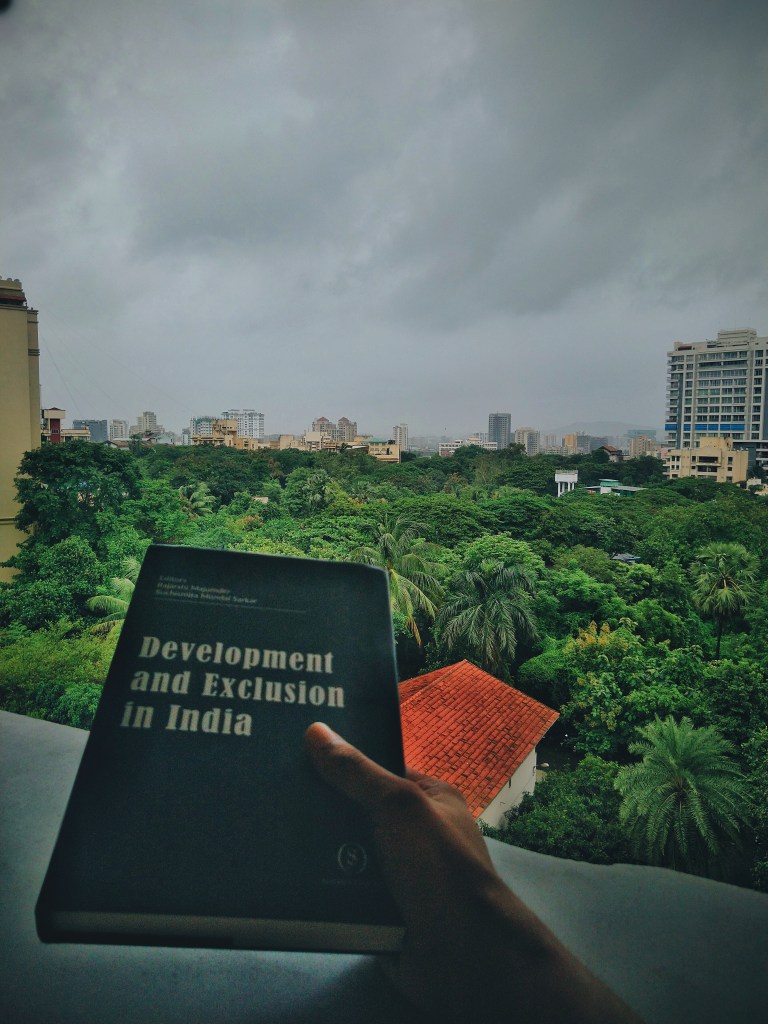
Pic 1: How we study development and exclusion sitting at a vantage point.
Abstract
Taken from the 7th floor of TISS Mumbai, the picture shows the privileged position we sit at while discussing the development and exclusion in India. The discussion on the topic of exclusion has become a talk of the day now. With this essay we will take a visual journey of how the state failure has led to cynicism in the rural people, making villages, as described by Jonathan perry as “waiting rooms”.
The literatures have very often mentioned the push and pull factors of the cities attracting a large number of rural populations towards it, but it has rarely tried to figure out the transition of the state with the people moving from the village to a city. People living in the villages very often feels that they are being neglected by the state and move toward the cities, getting attracted by its dazzling skylines. Through this essay we will try to visualize the state dynamics in different geographies by tracing an example of a migration from a village toward the city, but ending up in the slums. We will try to figure out “How does migration change the relation of an individual with the state?”
Over 2500 years ago, Plato has observed that any city irrespective of its size, is divided into two, one the city of the poor, and the city of the rich. This is true even in the contemporary times. There is an ongoing debate whether cities make people poor or it attracts poor people. To some extent, it is true that the proliferation of slums is a result of poor urban planning and the ignorant nature of the state. The people living in the villages believe that moving to a city is the best way to escape their poverty but we will see that even after travelling a horizontal distance of thousand kilometres, they failed to travel the vertical distance.
“The country that is more developed industrially only shows, to the less developed, the image of its own future.”
~Marx, Preface to the German edition of Capital (1867)
The Aspirational Story of Chatra
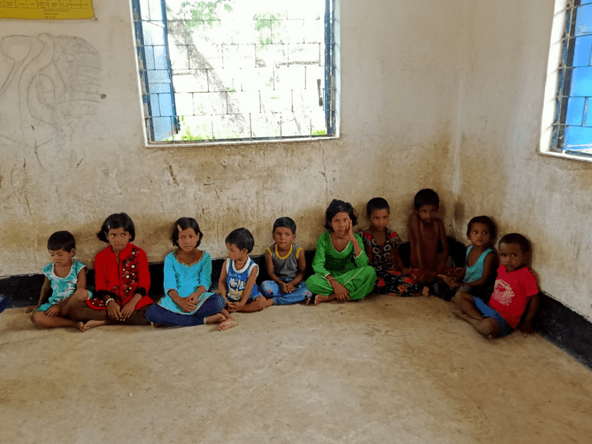
Pic 2: Children sitting in the classroom of an Aanganwadi set up under the ICDS program
In the month of August in 2019, I Visited Chatra District in Jharkhand, experiencing the dynamic aspects of life there which certainly made me feel, something is not right! Chatra is one of the thirty-five Left wing extremism affected districts listed by NITI Aayog under its Aspirational Districts Program (ADP). One need not be a genius to diagnose the problem. I went to the various state institutions like public schools, health centres, aanganwadis, Panchayat Bhavan etc. of the district and also interacted with the families living there. I realized various issue like malnutrition, poor education, insufficient income, inferior health facilities and top of all the poor convergence of government schemes there.
As part of my field visit, I had an interaction with the children, farmers, labourers, women, elderly people, and local officials but one thing I found in common among all of them was their expression of resentment toward local officials and an expression of aspiration toward the cities at the same time. The existing conditions of their village and the fascinating skylines of the cities has led them to conclude that moving toward the cities is the solution for all their problems.
The state is almost invisible in their thoughts, if not in their everyday lives. Even if they try to visualize the state in their daily lives, they see it in a very negative way, making it responsible for all their problems. They are devoid of even the basic necessities of life: Food, shelter and cloth. I found them hardly sustaining their lives.
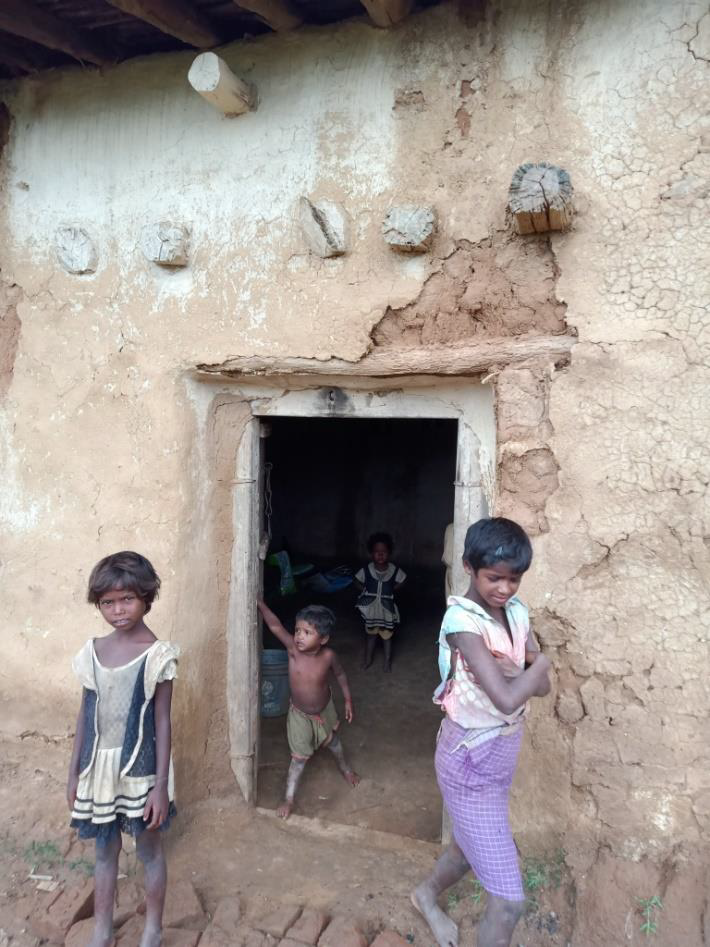
Pic 3: Little Things: A home I visited in Chatra. The kids rejoiced looking at the visitors to their places. When I was taking the picture, the kids wanted to pose for it and came running to me.
This picture itself reflects the existing situation there in the villages. Although there were a lack of proper food, housing, cloth and education, still the smiling faces and twinkling eyes of these children reflects their aspirations and willingness to be someone like us. They are unaware of the world outside their village or city, but the state is not unaware of these children living in such conditions. Still it chooses to be a passive spectator there.
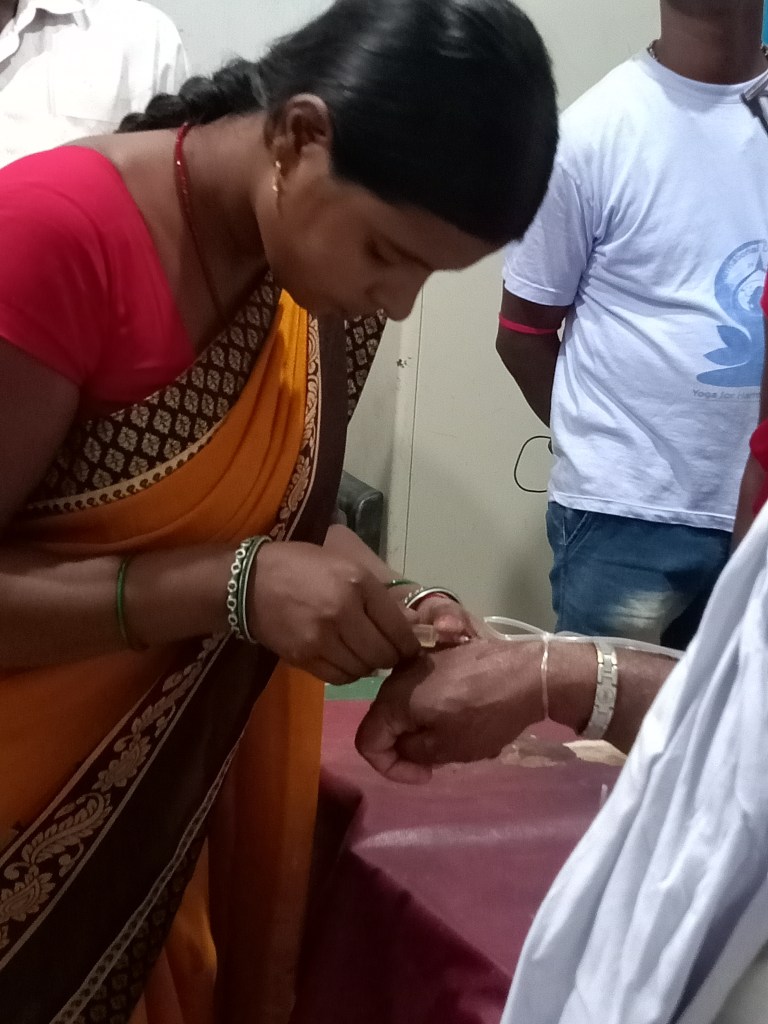
Pic 4: A nurse in the local hospital giving injection to a patient without any consultation or administration from a certified doctor.
The health facilities were terribly bad, the doctors were unavailable. The patients were severely neglected. The people had to travel miles to go to the city hospitals to avail health facilities. All of them were provided with Ayushman Bharat cards but the utility of which was nearly impossible there. Doctors and nurses were very poorly trained.
“Entering into their dream world”
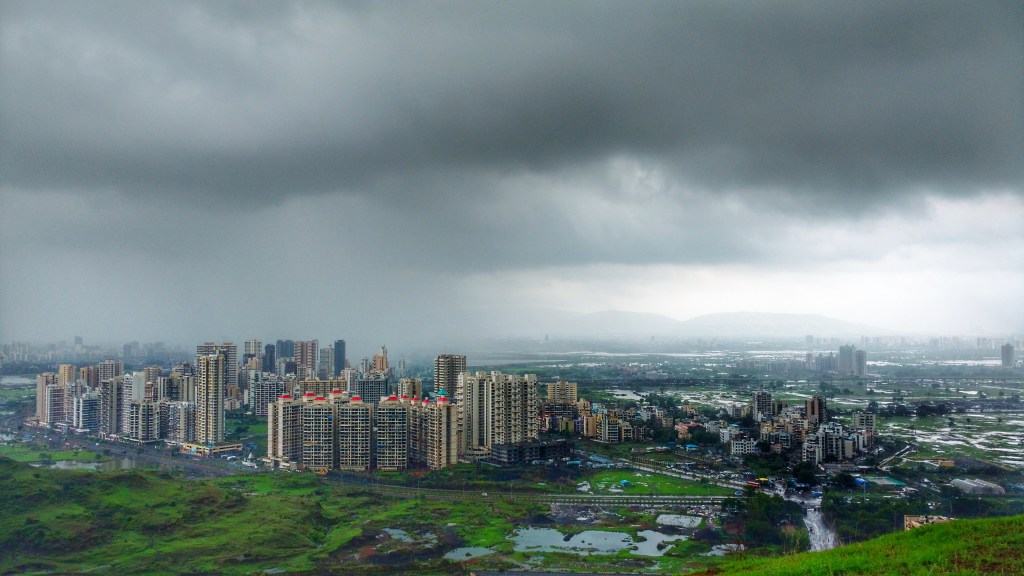
Pic 5: View of Kharghar from top of a mountain. Kharghar is part of one of the world’s largest planned cluster of cities in Navi Mumbai. August 2019.
The vision of a city is promising and full of hope. Mumbai in particular has historically been the city for inward migration. It has absorbed everyone coming here with the hope of occupation. The city shows the marvelous success of policies brought in for development. It has constantly replaced itself from the bottom for reaching the new heights. These vibrant and well-planned structures in the cities becomes the dream for everyone to live.
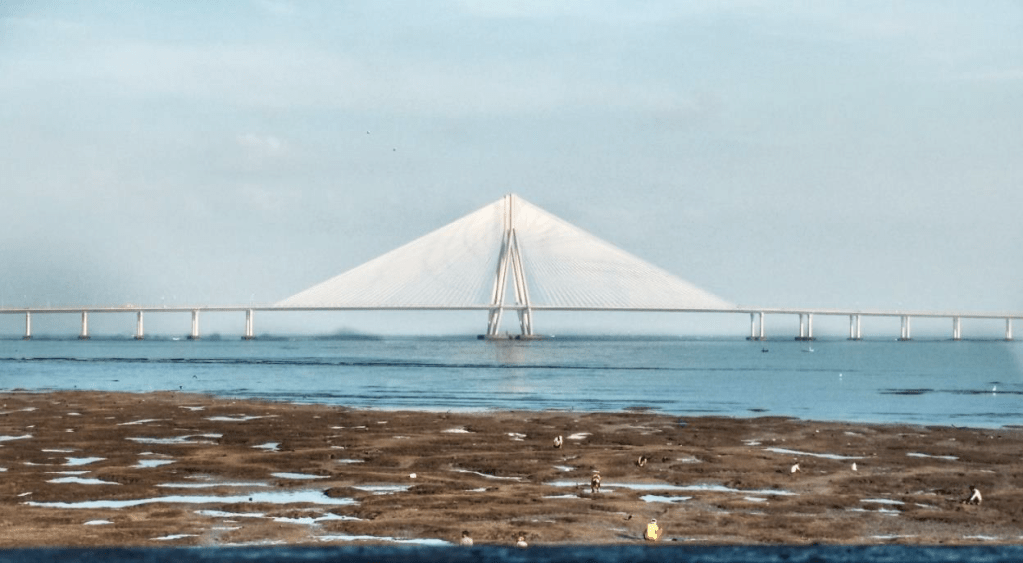
Pic 6: Miraculous architectures are created by the state to aid its movement
“Is the city actually the city of dreams or just a city of broken hopes?”
The stunning progress of the city will make it an envy for anyone envisioning the paths of development. But when we look at the city from a different perspective, it is then we get to the bottom of this development. (Pun intended)
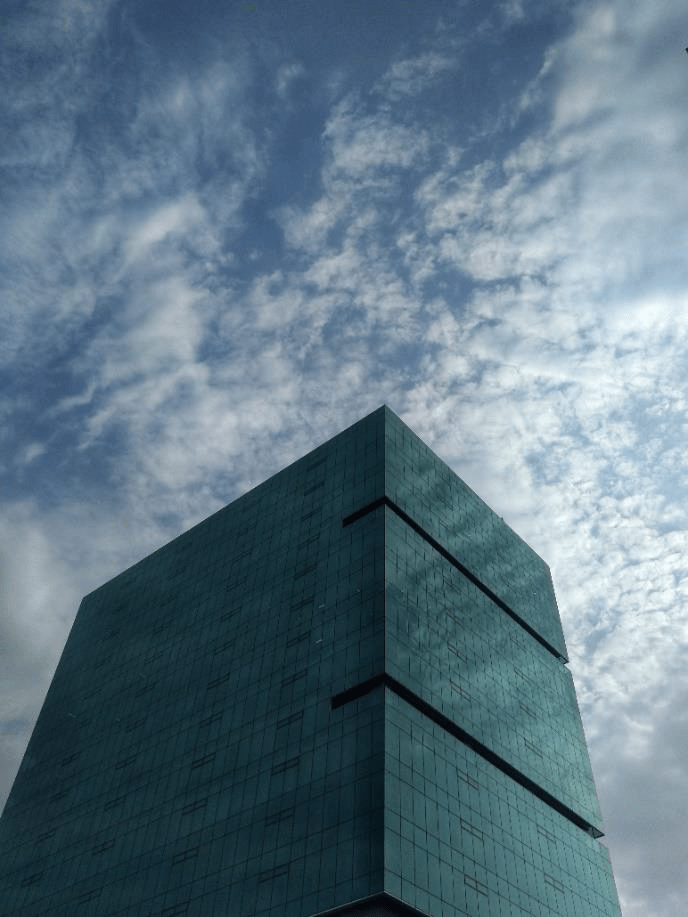
Pic 7: Magnificent buildings in the city touching the sky.
As this city rises to the sky, it changes the realities at the bottom. The dynamics which change at the bottom affect a million lives living here. No one comes here to live in the realities of this city. I find it poetic that from far away, one can only see the tall buildings, just like a mirage, only when we come closer do, we see what lies beneath.
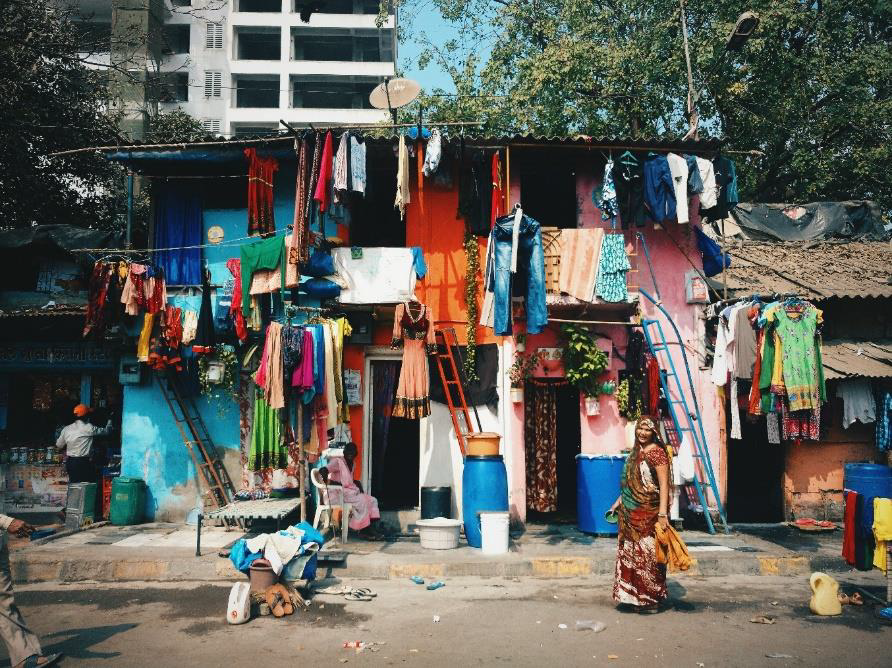
Pic 8: This house in Wadala is an example of what exists alongside a road. In the background, a building rise. These houses will be destroyed soon to accommodate more skyscrapers.
The poor live in the polar opposite of what is seems like the shining and dazzling Mumbai. The houses in such conditions, the filth so bad, one would question why people even choose to come here. Most of the population lives in houses made on the roadsides, on Bridges, houses made on mud where water gets filled every rain. The poor quality of education in the villages is replaced by good quality of expensive schools in the city. Making it unaffordable for the poor and many middle classes alike. The health facilities have the same story. Either poor or inaccessibly expensive. There is no in-between.
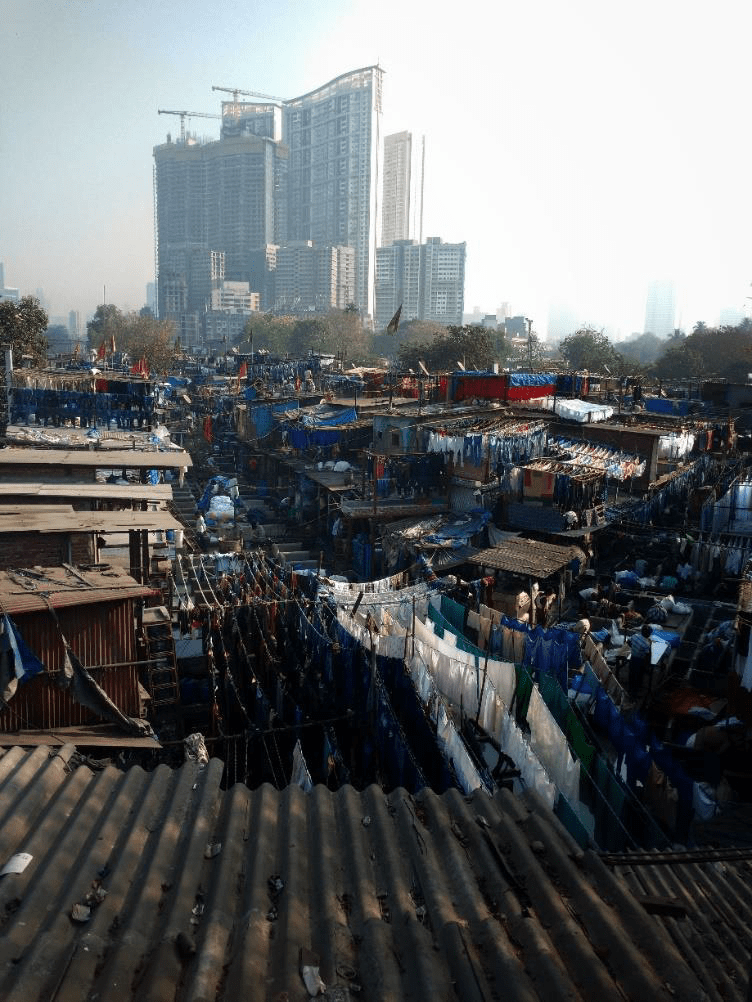
Pic 9: This is the iconic Dhobi Ghat near Mahalaxmi station of Mumbai. We see the slums and at a distance, skyscrapers rise to touch the sky.
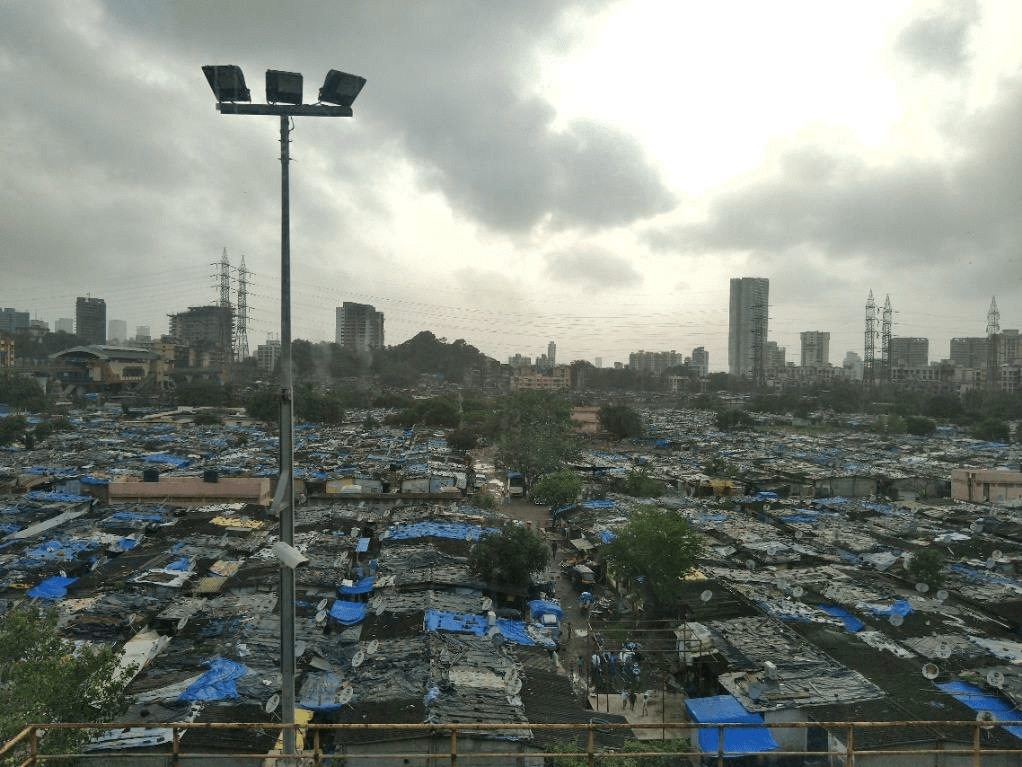
Once in a while, the state does choose to regulate the housings in the city, the poor get government made houses with it. Isn’t it the benevolence of the state? Not really, the houses are made just to replace the poor to make more space for the rising city. When these houses are promised, tall claims are made, number of facilities are promised. Sometime the threat of getting declared illegal is enough. When the father of those kids came to Mumbai, the kids would imagine an optimism of a better future. An optimism which would be conflicting with the pessimism and cynicism they are living with.
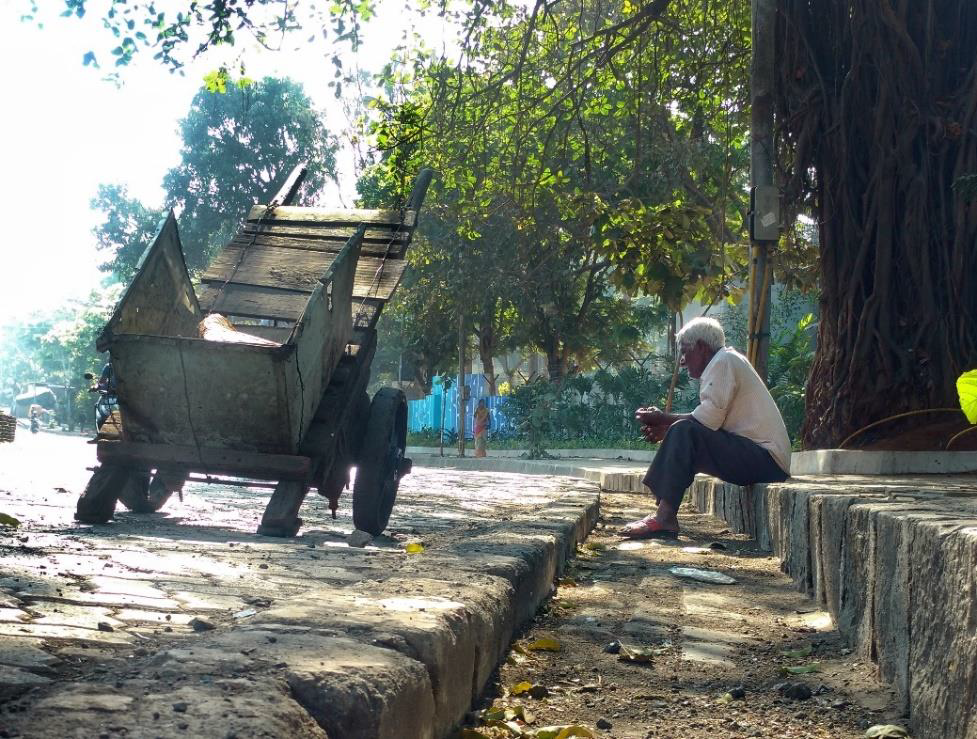
Keeping this all aside, people come here for jobs and earning. The cities once grew so fast that it was welcoming everyone. Now with all the services taken up by the newly emerged platforms where you need a local house address to get enrolled, a level of education necessary to function and a steep competition, what a migrant is left with is just their physical labour. The role of state is to accommodate everyone equally. Formal labour availability is being reduced. The policies brought in for the spectacular developmental landscape every time comes with a cost. It has costed the homes and spaces for the hard-working migrant labour. It has costed health care for the poor; it has costed occupation for anyone who isn’t qualified according to the policies of the state.
Pic 10:The houses made by the rehabilitation authority; the region almost looks like a ghetto.
The State which failed in bringing development in Chatra failed again here in the cities when it creates spectacles of development like in Mumbai. The result of which is, a desperate labourer who fights cynicism and pessimism in his Village can successfully managed to cross a horizontal distance of 2000 km to reach this city, but would never be able to cross the vertical distance this city is growing to. Although the relation of the state with these people remains constant, but now it appears with a new face. “What was before inaccessible for them, have now become unaffordable.”
Pic 11: An old man engaged in an informal labour for his livelihood.
 The Silly Season